Why BIGHEAD™ Tipi Tents
A design that changes how guests experience space.

Living in a tipi creates a different rhythm of space.
Most guests arrive with noise in their heads. A tipi dismantles that within minutes. The circular geometry does something rectangular rooms cannot: it removes corners, eliminates the visual hierarchy of walls, and draws the eye upward toward the crown.
Unlike square rooms that separate us, the circle brings us together.
True grounding is rare. A tipi restores it. Living in a tipi brings you back to what matters most.
Modern walls are built to isolate. They separate you from weather, light, and sound. A teepee works differently. It filters the environment instead of blocking it.
A tipi doesn’t push you to move faster. It slows you down. It lets you breathe. There is no need for a clock here. The fire sets the rhythm. The light defines the pace.
It’s a slower way of living. A simpler way. A better way.
Whether for a luxury glamping resort, a forest kindergarten, or a private meditation sanctuary, a tipi offers a deeper connection to nature, beyond what conventional buildings can achieve.
Built to last in the field.
Not just in a showroom.
Hand-crafted precision, never mass-produced.
Every BIGHEAD tipi is sewn individually in our European workshop. We do not produce on assembly lines. Industrial-grade machines handle the heavy stitching, but every seam is guided and inspected by hand. Because each tipi is built one at a time, we verify every stress point before it ships.

The wooden poles is engineered to withstand sustained winds of up to 100 km/h. The canvas is double-reinforced at critical stress points, the peak, door frame, and every anchor loop, where tension concentrates during storms.
- Authentic geometry:
We follow the specific “three-pole” structural design of the Sioux tribes. This is not merely aesthetic; it creates a tilted cone shape that is aerodynamically superior to symmetrical tents, allowing for better smoke ventilation and wind resistance. - The human touch:
We use industrial-grade machines for strength, but the control remains human. We reinforce critical stress points with double layers and heavy-duty stitching, because we understand the forces that nature can apply. - Unique Character:
Because each tipi is handmade, no two are exactly alike. This custom approach ensures that every tent is a unique piece of craftsmanship. It also drives us to continuously refine our techniques and sewing methods. Every tipi must meet our strict standards before it leaves the workshop. - The Technique:
A machine is only as good as the hands that guide it. Our seamstresses use specialised lockstitch techniques. We reinforce critical stress points with double layers: at the apex, door frame, and anchor loops, where the loads are greatest. - The Thread:
We use SunUV® Protection thread. It is waxed, impregnated, and manufactured for UV resistance. While standard cotton thread can rot after a few seasons of sun and rain, our stitching is designed to withstand the elements.
Materials with documented origins
All canvas is manufactured within the European Union and sourced from regulated, trusted suppliers. Before any fabric enters production, it is tested against our specifications for breathability, water resistance, and tensile strength.
- 100% European Origin:
All our fabrics are developed and manufactured within the European Union. We do not use materials from Asia or unregulated markets. - Selective Sourcing:
We have spent years testing different canvas weights and weaves. We only select fabrics that meet our specific criteria for breathability, water resistance, and environmental safety.
Natural materials for a healthy environment

The canvas colors are warm and natural. They filter daylight into amber tones inside the tipi. Guests notice the quality of the light before they notice anything else.
We believe that shelter in nature should be made from materials that feel natural, familiar, and safe. That is why we use warm, natural colour tones. They influence how people feel and how they behave inside the space. The result is a calm, grounded environment that supports rest, focus, and presence, rather than distraction.
- The Canvas:
We use fabric with the Oeko-Tex Standard 100 ecological certificate. This ensures the material is free from harmful substances and safe for prolonged contact with skin. Suitable for kindergartens. - The Wood:
All structural timber is protected using only water-based ecological coatings. - The Interior:
When outfitting the interior, we prioritise natural materials: cotton, stone, wool, and leather.
A dedication to natural materials creates a space that is warm. Sunlight passes through the canvas, softened into a warm amber glow and shaping a calm, restorative atmosphere.
We rely on traditional, natural materials such as cotton, wood, stone, wool, and leather.
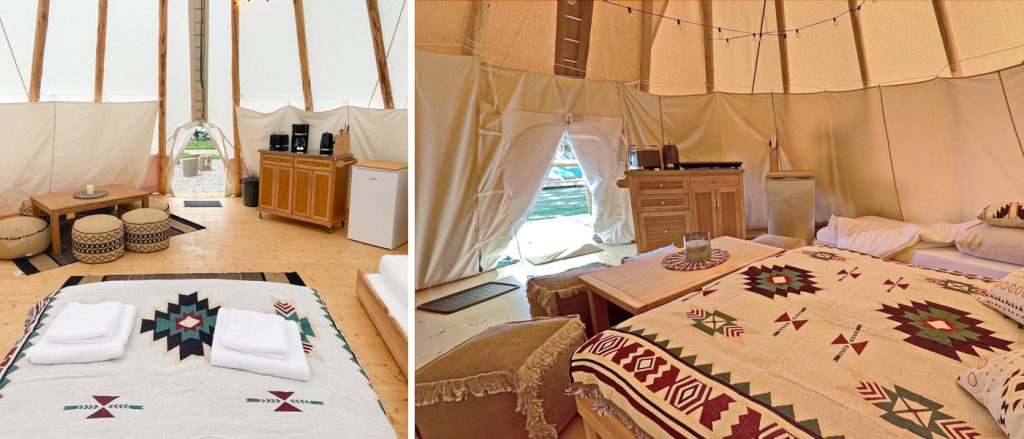
The double-wall system

A common misconception is that a tipi is just a single layer of cloth. A properly set up BIGHEAD tipi functions as a sophisticated double-wall structure.
- The Outer Shell:
The exterior canvas is thick, tightly woven, and robust, serving as the first line of defence against rain and wind. - The Inner Liner (The Air Channel):
Inside, we install a secondary curtain (liner) that runs around the perimeter. This creates an insulating pocket of air between you and the outer wall.- Ventilation:
This gap creates a “chimney effect.” Fresh air is drawn in from the bottom, warms up, and rises between the canvas layers to exit at the top. - Smoke Management:
This continuous airflow allows you to have an open fire or stove inside the tipi without the interior becoming smoky. The smoke is naturally drawn up and out. Thanks to this system, an open fire or stove can be used inside the tipi without smoke disturbing the guests.
- Ventilation:
The BIGHEAD™ Extended inner curtain
We have evolved the traditional design to suit European climates. While the standard Native American inner liner (Basic inner curtain) stands at 170 cm, we have developed an extended inner liner.
This wider, two-part liner extends higher towards the top of the tent, finishing with a narrow upper section.
This updated inner curtain extends much higher towards the apex of the tent, narrowing as it rises.
- Heat Retention:
By enclosing more of the living space, it traps significantly more heat, reducing the volume of air you need to warm up. - Extended Season:
With the extended inner curtain and a wood-burning stove, the tipi becomes a viable dwelling for cooler transition periods (spring/autumn), not just summer.
Because of extended inner curtain, the tipi is suitable not only for summer use but also for transitional seasons, especially when combined with a stove.

Wind stability and load resistance
The wooden frame is formed from solid spruce poles, combined with high-density woven canvas. This creates a system that delivers both structural strength and controlled flexibility.
BIGHEAD™ tipis are designed to withstand wind speeds exceeding 100 km/h when properly installed. The conical form plays a key role: allowing wind to flow around the conical form structure rather than pressing against flat surfaces.
The Sioux & Cheyenne Geometry
Not all conical tents are true tipis. BIGHEAD tents are built strictly according to the authentic “three frame poles” setups used by the Sioux and Cheyenne tribes.
- Why Three Poles?
This specific three-pole frame setup creates a slightly tilted cone shape, rather than a symmetrical cone. The rear is steeper, and the smoke opening is positioned at the front in the lee, which prevents wind from entering the tent. - Aerodynamics:
This asymmetrical shape is not just aesthetic; it is engineering born of survival. The wind flows around conical form structure of the canvas, finding no flat surface to push against. In addition, the back of the teepee is more upright and the front of the teepee is slightly sloping, all for the purpose of stability in the wind. - Stability:
When pitched correctly with our heavy-duty spruce poles, a large BIGHEAD tipi can withstand wind speeds exceeding 100 km/h.
Evolution of a classic
Indigenous peoples built tipis for survival, not for display. Their shelters were designed to retain warmth at temperatures as low as -15°C on the open prairie, shed heavy rain, and be assembled teeppe tent or dismantled in under an hour. Every design decision served a functional purpose. Traditional teepees rarely exceed 5 metres in diameter. This size limit was intentional, as smaller spaces require less fuel to heat.
BIGHEAD tipis are larger. Modern glamping guests and event operators require interior space beyond what traditional dimensions were designed to accommodate. However, scaling a tipi is not a simple matter: increased canvas surface area introduces higher wind loads, greater seam tension, and structural demands that exceed the limits of the original configuration.
We solve this with modern industrial sewing techniques, using strong double seams. The shape of the tent remains unchanged. Only the canvas surface area is increased, with tensile forces fully accounted for.
The Canvas:
Technical textiles that do the work
Built to carry tension, not just provide cover.
Why fabric quality actually matters?
A tipi places demands on fabric that a standard tent does not. The canvas is under constant radial tension. Pulled outward by the pole structure and downward by its own weight. Exposure to sun is direct and continuous. Rain can load the surface for days at a time. The seams at the peak and anchor loop carry the highest stress, and they carry it continuously, not only in extreme weather.
We do not use cheap canvas materials or bulk imports from Asia.
Conventional canvas fabrics often fail under these conditions within a season or two. They lose tension, fade, and begin to sag long before their waterproofing properties degrade. We have tested enough materials to understand the difference.
BIGHEAD canvas is sourced from EU manufacturers and engineered specifically for conical structures. The weave density is carefully selected to maintain stable canvas tension under radial load for many years.

Two type of fabrics
We offer two distinct fabric classes.
Each selected for specific environments and uses.
PolyTCP™ (470 g/m²)
USED FOR:
Glamping sites, festivals, public venues, retreats and humid locations (humid enclosed spaces, forest glades).
Technical evolution: a fabric that looks natural but performs like a shield.
Certified Fire Safety (Class 1 / Ignifugo):
100% Fire-Retardant Polyester – A 470 g/m² woven polyester fabric (16/2 Ne yarn count) with a soft-hand finish.
Acrylic Resin Coating:
Provides superior resistance to mold, moss, and bird droppings. Dirt does not penetrate the fiber, making maintenance significantly easier for business owners.
Double-Resin Coating (Bi-Resinato):
The double coating creates a robust barrier. It is oil-repellent (oleorepellente) and water-repellent (idrorepellente). Bird droppings, tree sap, and cooking grease wipe off with ease.
The “Textile Touch”:
Unlike PVC, which feels like cold plastic, this material retains a soft, fabric-like texture, preserving the premium feel of your resort.
Anti-Mould & UV Preservation:
Treated with specific anti-mould agents and boasts a UV colour resistance of 6/8 (ISO 105 B02). The anti-mould treatment fights off the funk that kills traditional tents.
Low Maintenance cost:
You do not need to “season” this canvas like old-school cotton. It is ready for the storm the moment you pitch it. Beside is more resitance to mold and easy to clean.
Water Column: 1,000 mm:
Tested to withstand a 1,000 mm hydrostatic head (ISO 811). Water cannot pool; it accelerates off the coated surface. You stay bone dry.
PolyTCP™ (430 g/m²)
USED FOR:
Private sanctuaries, kindergartens, eco-resorts, and dry sunny climates (breathable open spaces).
This fabric honors tradition while embracing safety.
Breathability:
The weave allows moisture to escape, preventing the stuffy, humid air common in synthetic tents.
PFAS-Free Waterproofing:
We use a new generation of waterproofing agents that are free from harmful PFAS chemicals. This creates a hydrophobic barrier that repels rain without leaching toxins into the soil or your skin.
Health Conscious:
With Oeko-Tex Standard 100 certification, this textile is safe enough for children to touch and play against all day.
Anti-Fungal Treatment:
Natural cotton is vulnerable to mildew. This treatment prevents the canvas from decomposing even if pitched in damp woodlands or packed away slightly moist. But don’t do this.
UV Resistance:
The sun is the biggest enemy of tent fabric, turning nylon brittle in a single season. High-grade UV stabilisers are integrated into the fabric dye and coating.
Certified Fire Safety (M2 / B2 / CPAI84 / NFPA701):
In the unlikely event that a stray ember from a fire lands on the canvas, the fabric will self-extinguish. Canvas may char and darken locally, but it will not melt or ignite like standard leisure tents.
Hydrophilic & Waterproof Engineering:
A dual-action finish that is water-repellent on the outside and hydrophilic (moisture-managing) on the inside. Inside, the fabric manages humidity so the walls do not feel clammy to the touch. You stay dry without feeling sealed in a plastic bag.
Both fabrics are developed and manufactured in the EU.
(no low-cost import)
Fabric certificate:

Structural and construction features
A tipi holds its shape through tension, not rigidity. There are no zips, no aluminium extrusions, and no internal frame assembled on site. The tent works because the canvas is stretched between poles at precise angles.
What follows are the specific features that make a measurable difference in the field and why each one matters to operators running tipi tent across multiple seasons.
- Authentic geometry: The physics of the shape:
Most commercial tipis on the market are simplified into symmetrical cones, essentially an inverted ice cream cone. While easier to manufacture, this shape is functionally incorrect for a dwelling. We construct our tipis with the authentic, asymmetrical geometry used by the Sioux and Cheyenne tribes.- The “Egg” Floor Plan:
A true tipi is not a perfect circle at the base; it is slightly ovoid (egg-shaped). - Variable Slope:
The back of the tipi is steeper than the front. - Why This Matters:
This shape is aerodynamic, allowing the structure to brace effectively against wind and significantly improve stability during storms. With the rear of the tent facing the wind, airflow is deflected away from the chimney opening, preventing wind from entering. As a result, smoke is able to exit normally without being drawn back into the interior.
- The “Egg” Floor Plan:
- The chimney: Reinforcing the stress points:
The smoke flaps (chimney) represent the most mechanically active part of the tipi, constantly exposed to changing air currents.- Double-Pocket Construction:
The pole pockets are sewn with a double layer of heavy-duty canvas and reinforced stitching. - User Benefit:
This prevents the fabric from tearing and the poles from slipping out. It allows the chimney poles to be adjusted reliably without the risk of damaging the fabric, even in variable wind conditions.
- Double-Pocket Construction:
- Industrial-Grade seams and thread:
A tipi tent is only as strong as its stitching. We use high-tensile industrial thread specifically engineered to resist UV degradation and moisture exposure.- Stitch Density:
We apply a high-density, double-stitched sewing using tight, reinforced seam. - Critical Reinforcement:
At every primary load point: the apex lifting point, base peg loops, and door attachments, we apply additional double-layer fabric reinforcement. - User Benefit:
This eliminates the “pinhole effect,” where stitch openings can expand and allow water ingress over time. It also ensures the tent can be tensioned drum tight, essential for effective water runoff, without risk of seam failure or fabric tearing.
- Stitch Density:
- The entrance: Weather protection and security:
We have modernized the traditional entrance to meet the demands of contemporary camping and glamping, without compromising its aesthetic integrity.- The integrated rain channel:
A specially engineered diversion channel is positioned directly above the door. Rainwater flowing down the canvas is collected and redirected to either side of the entrance, preventing water ingress. - Security features:
In addition to traditional lacing pins, we offer a heavy-duty zipper system that allows the entrance to be fully closed and secured. This is a critical feature for glamping sites and long-term installations where security is essential. - Anti-Fraying details:
All lacing holes and fabric edges are individually reinforced with stitching to prevent fraying, ensuring a clean, durable entrance even under frequent use.
- The integrated rain channel:
- Aesthetics with purpose:
While function comes first, the visual identity of the tipi remains essential to its character.- Decorative Options:
We offer traditional entrance tassels that add movement and subtle visual expression without compromising function. - Correct Silhouette:
By adhering to authentic geometric principles, the tipi maintains a clean, well-defined silhouette against the landscape, distinct from the sagging forms often seen in lower-quality imitations.
- Decorative Options:
- Aerodynamics (wind resistance):
- The Tilted Cone:
The three-pole, Sioux-style construction forms a subtly sloped cone with a steeper rear section. While this geometry allows for efficient smoke ventilation, its primary advantage is aerodynamic. It reduces wind resistance and improves stability in windy conditions. Airflow passes over the frame rather than exerting direct pressure on the structure. - Load distribution and anchor stability:
The three-part system is connected at the apex with strong knots. The remaining poles rely on this primary structure, distributing the load evenly and supporting the entire tent.
- The Tilted Cone:
Consultation & longevity
Service beyond the sale
We deliver solutions, not just canvas. Our focus goes beyond the initial purchase, towards long-term performance, durability, and suitability in real-world conditions.
A tipi is a living structure. Its longevity depends entirely on where it stands. We do not believe in a one-size-fits-all approach.
Before recommending a specific canvas or configuration, we begin with a fundamental question: “Where will this tent live?”
- The Location:
A tipi placed in a damp, shaded river valley requires different material specifications than one installed on a dry, sun-exposed, wind-swept hill. - The Duration:
Will the tent remain in place year-round, or be used seasonally?
A tipi placed in a damp, shaded river valley requires different material specifications than one installed on a dry, sun-exposed, wind-swept hill.
We do not offer generic solutions. Instead, we provide precise guidance on fabric weight, construction, and treatment based on local microclimate conditions. The goal is simple: to ensure long-term durability and protect your investment for years to come.
We offer full support (you’ll need it):
- Customization:
Available diameters range from 4.2 m to 9.5 m, accommodating up to 25 people. You can select canvas type, entrance system (traditional lacing or zipper), and optional hand-painted artistic details. - Expert Guidance:
We provide detailed visual instructions and, more importantly, practical field knowledge. Proper tension and pole placement are critical for stability and weather resistance. - Maintenance & Repair:
We maintain a stock of spare parts and offer repair services. In addition, we advice on suitable cleaning agents to preserve water resistance performance and how to extend the lifespan of the canvas. - 2-Year Warranty:
We stand behind our craftsmanship and materials with a 2-year warranty. - We do not sell generic tents:
We provide architectural solutions for living closer to nature.
The word tipi translates roughly to dwelling or shelter. That is exactly what we aim to deliver.
BIGHEAD™ tipi are designed for:
- Transitional and summer living
- Strong winds
- Changing weather conditions
Crafting a tipi is complex. It demands a precise understanding of cone geometry to ensure the tent stands taut and true, without sagging. It requires strength to handle the heavy canvas. Above all, it requires passion.